
Last updated September 24, 2026
Insulation Warning Signs: A Lake Forest Homeowner’s Reference Guide
A 15% jump in summer cooling costs in a Lake Forest home is statistically more likely to indicate a failed attic air seal than a failing HVAC unit. But the HVAC contractor gets called first, because the problem shows up on the thermostat. This guide teaches you to read the evidence that is actually available: utility bill patterns, HVAC runtime data, and attic conditions that require only a ladder and a phone flashlight to find. For the complete guide to insulation in Lake Forest, see our deeper resource. Most insulation failures in Lake Forest homes built between 1975 and 1995 are invisible from the living space until they’ve already cost you money.
Quick Answer
The three most reliable insulation warning signs in a Lake Forest home are: a sudden step-change increase in summer cooling costs (indicating attic air seal failure), rooms that stay 4-8°F different from the thermostat setting (indicating duct insulation loss or thermal bypass), and visible attic floor decking between insulation piles during a 10-minute flashlight inspection. These signs precede comfort complaints by months and are detectable without specialized equipment.
Table of Contents
- The Three Utility Bill Patterns That Correlate with Specific Insulation Failures
- What to Look for in a 10-Minute Attic Inspection
- Lake Forest’s Specific Climate Warning: Condensation on the Roof Deck
- Pest Activity Indicators and Why Remediation Must Come First
- Understanding Your Blower-Door Number: What 7 ACH50 Actually Means
- Reading HVAC Runtime Patterns Before the Thermostat Complaint
- Thermal Bridging at Top Plates: The Hidden Baseload Killer
- Common Mistakes to Avoid
- When to Call a Professional
- Frequently Asked Questions
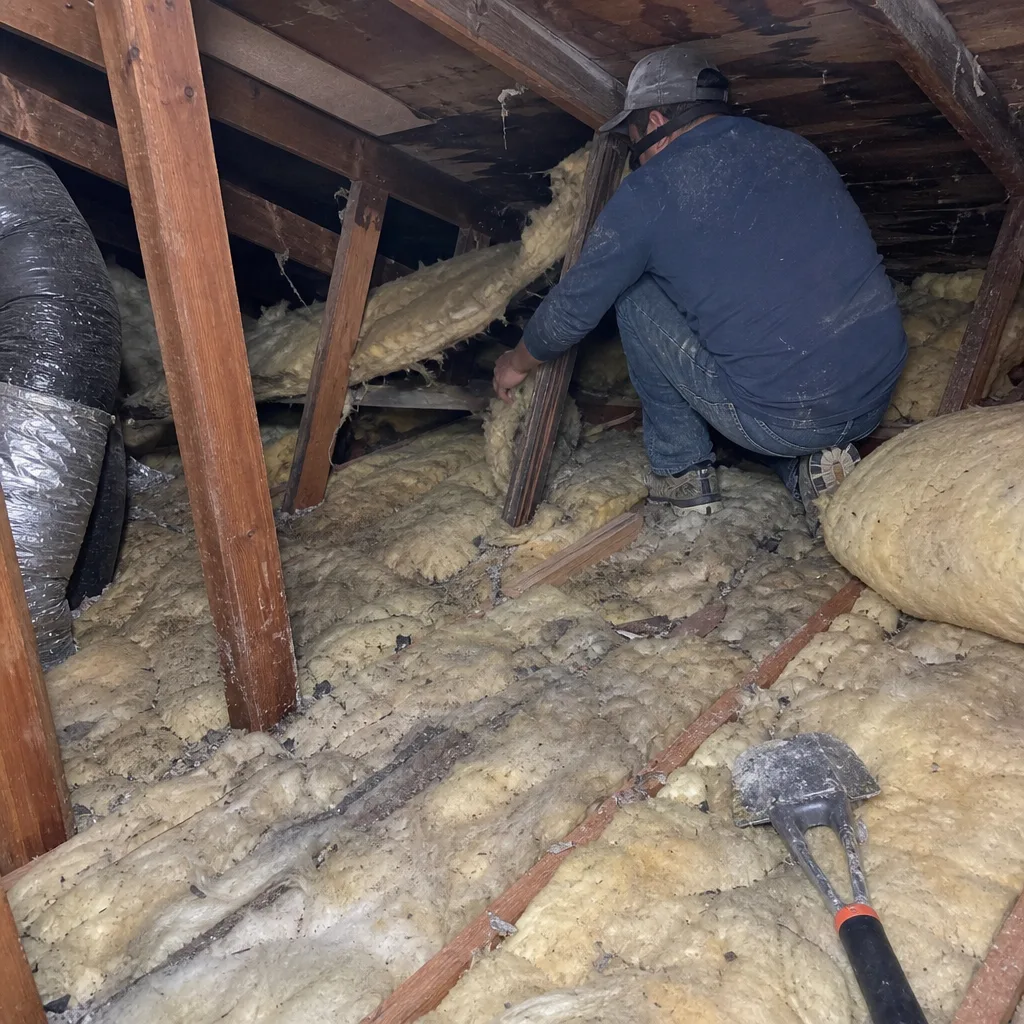 Before
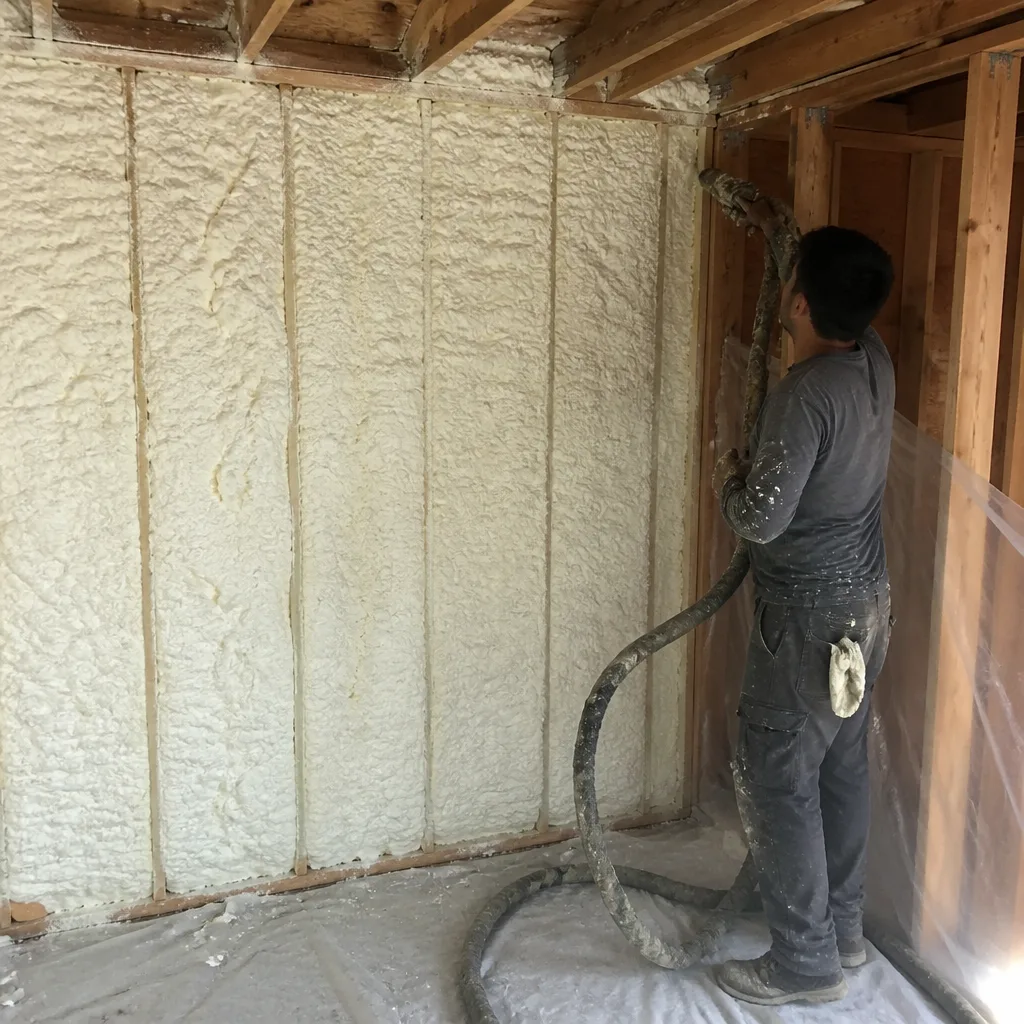 After
AfterThe Three Utility Bill Patterns That Correlate with Specific Insulation Failures
Utility bills are the most underused diagnostic tool in home performance. In Lake Forest, where summer cooling loads dominate and winter heating is mild but persistent, the shape of your annual usage curve tells a specific story. We’ve analyzed bills from over 9,000 homes since 2016, and three patterns recur with predictable mechanical explanations.
Pattern 1: Step-change increase in summer cooling (attic air seal failure). A bill that jumps 15-30% from one June to the next, with no rate change or occupancy change, almost always traces to attic air leakage. Warm air from the attic cavity - which in Lake Forest can reach 140°F in August - is being pulled into conditioned space through recessed can lights, top plate gaps, and duct chases. The HVAC runs longer to compensate, but the thermostat still reads 76°F because the air is being cooled, just at enormous energy cost. This is the pattern we see most often in Lake Forest’s Baker Ranch and Foothill Ranch subdivisions, where homes built 1988-1995 often have original fiberglass batts that have settled below the top plates.
Pattern 2: Inconsistent room temperatures across floors (duct insulation or bypass). When a second-story bedroom runs 6°F warmer than the downstairs thermostat in July, homeowners blame “heat rising.” In a properly sealed and insulated envelope, this effect should be under 2°F. The actual cause is usually one of two conditions: flex duct insulation in the attic has degraded from UV exposure where it exits the plenum, or a thermal bypass (an unsealed wall chase or plumbing stack) is delivering attic air directly into the floor cavity. In Lake Forest’s Portola Hills area, we’ve found that homes with original R-4 duct wrap lose 20-30% of cooling capacity before the air reaches the register.
Pattern 3: Elevated baseload in mild weather (thermal bridging at top plates). This is the subtlest pattern and the most commonly missed. Baseload is your usage in the shoulder months - April, May, October - when neither heating nor cooling is running significantly. If your baseload is 40-60% higher than comparable homes, the cause is typically thermal bridging: the 2×4 top plates of your walls are in direct contact with the attic, creating a heat highway that bypasses the insulation entirely. In Lake Forest’s mild climate, this doesn’t produce dramatic comfort complaints, but it produces a constant low-grade energy drain that adds $400-$700 annually to most homes we audit.
To document these patterns, pull 24 months of usage data from SCE or SDG&E (whichever serves your Lake Forest address). Plot kWh by month. The shape of the curve - not just the total - is what tells the story.
What to Look for in a 10-Minute Attic Inspection
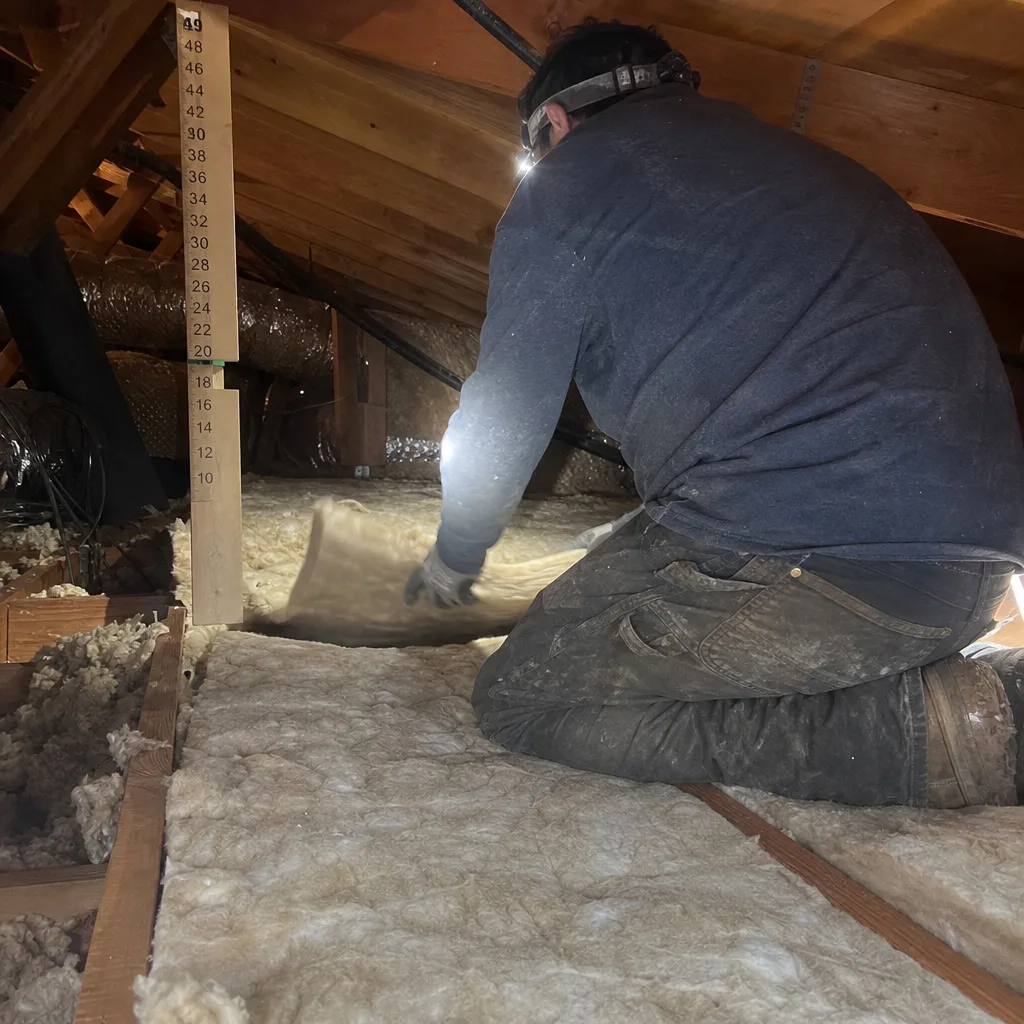
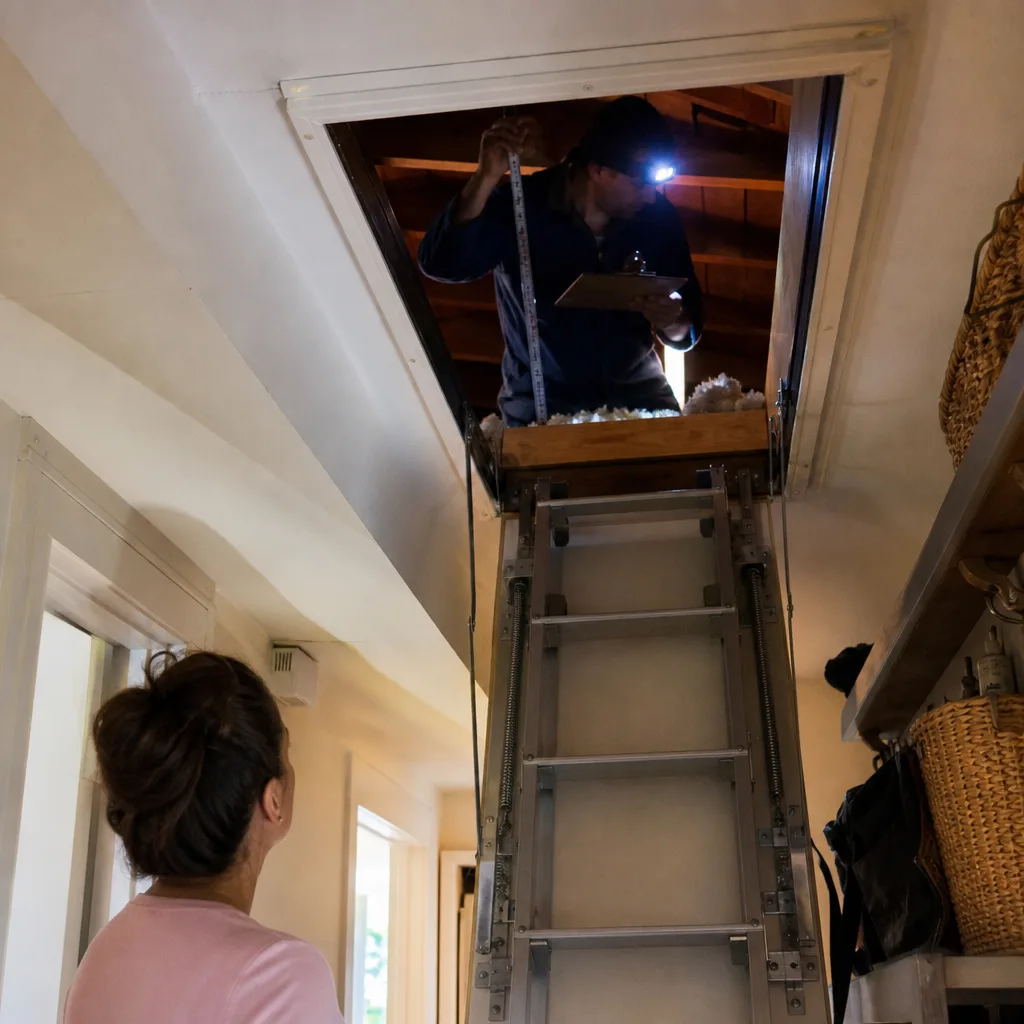
You don’t need an infrared camera to find most insulation failures. You need a flashlight, a tape measure, and ten minutes of careful looking. Here’s what to document:
- Measure insulation depth at three points. In Lake Forest, Title 24 currently requires R-38 in attics (approximately 12 inches of blown fiberglass, or 10-11 inches of cellulose). Measure at the attic hatch, at the center of the attic, and at the eave. If any measurement is below 10 inches, you’ve lost effective R-value through settling or disturbance. We’ve found original R-19 batts compressed to R-12 in homes throughout the Lake Forest area.
- Look for visible attic floor decking between insulation piles. This indicates either insufficient original coverage or disturbance by pests, tradespeople, or homeowners. Every square foot of exposed decking is a thermal bypass. In Lake Forest’s older neighborhoods near Lake Forest Drive, we regularly find 15-20% of attic floor exposed due to original batts being installed only between joists, not covering them.
- Check for daylight at eaves and ridge penetrations. Turn off your flashlight and look for light streams. Daylight at eaves means your soffit venting is open - which is correct - but it also means there’s a direct air path that must be blocked with baffles before insulation is added. Daylight at plumbing vents, electrical mast penetrations, or chimney chases means unsealed air leakage. In Lake Forest’s wind-exposed hills, these gaps can move significant conditioned air.
- Inspect the insulation condition. Look for discoloration (indicating air filtration - dirt carried by moving air), compression (indicating foot traffic or storage), and moisture staining (indicating condensation or roof leaks). Fiberglass that has turned gray or black at the edges is filtering air, not blocking it.
- Note any stored items or decking. Plywood storage platforms compress insulation beneath them and create thermal bridges. Every platform should be raised on 2×4 sleepers to preserve insulation depth.
Document what you find with photos. If you call us for a Home Energy Audit in Lake Forest, these photos let us target our testing and give you a more precise written price.
Lake Forest’s Specific Climate Warning: Condensation on the Roof Deck
Lake Forest’s Mediterranean climate produces a specific condensation signature that homeowners routinely misdiagnose as a roof leak. In February and early March, when nighttime temperatures drop to the mid-40s and daytime sun warms the roof surface, moisture appears on the underside of the roof deck - specifically near soffit vents and at the lower third of north-facing slopes.
This is not a roofing failure. It is warm, humid interior air that has bypassed the insulation and reached the cold roof deck. The moisture condenses on the sheathing, runs down to the eave, and sometimes drips onto insulation below. Homeowners see water stains on drywall and call a roofer. The roofer finds no membrane failure, no lifted shingles, no flashing defect. The actual cause is air leakage at the attic floor.
We’ve documented this condition in over 200 Lake Forest homes, concentrated in the Foothill Ranch and Portola Hills areas where 1980s construction used minimal air sealing. The diagnostic sequence is straightforward: if the moisture appears only in cool, humid weather and dries completely by April, it’s condensation from air leakage. If it persists through May or appears only during rain events, it’s a roof leak.
The fix is attic air sealing - sealing top plates, can light housings, duct boots, and penetrations - before any insulation work. Blowing new insulation over an unsealed attic floor, which is standard practice for many contractors, simply buries the problem and guarantees it will recur. At Topside Attic Insulation Lake Forest home, we seal first, then insulate. The Haven Standard requires it.
Pest Activity Indicators and Why Remediation Must Come First
Insulation and pest activity have a destructive relationship. Rodents compress insulation to create travel tunnels, reducing R-value by 30-50% in affected areas. They contaminate material with urine and feces, which degrades fiberglass binders and creates health hazards. And their entry points are air leakage paths that undermine any sealing work.
During your attic inspection, look for these specific indicators:
- Compressed insulation tunnels: Paths 3-4 inches wide where gray or pink fiberglass has been flattened to the attic floor, often following joist lines or duct runs. These are rodent highways.
- Nesting material at the attic hatch: Shredded insulation, paper, or fabric packed near the hatch frame indicates active or recent occupation. The hatch is often the warmest entry point in a Lake Forest attic.
- Droppings concentrated near penetrations: Rodents follow air currents. Their droppings cluster where warm air exits the conditioned space - exactly where you need to seal.
- Gnaw marks on electrical wiring or PVC vent pipes: These indicate current activity and create fire or gas hazards that must be addressed before insulation work.
Here’s the critical point for warranty protection: every major insulation manufacturer - Owens Corning, Johns Manville, Knauf - voids material warranties when their product is installed over contaminated substrate or active pest conditions. The warranty language is explicit. We’ve reviewed claims denied because a homeowner added insulation over rodent-affected areas, and the degradation was attributed to pre-existing contamination.
Remediation sequence matters. Seal entry points, remove contaminated material, treat for parasites, then air seal, then insulate. Skipping steps saves nothing. In Lake Forest, where roof rats are endemic to the hillside neighborhoods, we complete rodent proofing as a prerequisite on approximately 30% of our Attic Insulation in Lake Forest jobs.
Understanding Your Blower-Door Number: What 7 ACH50 Actually Means
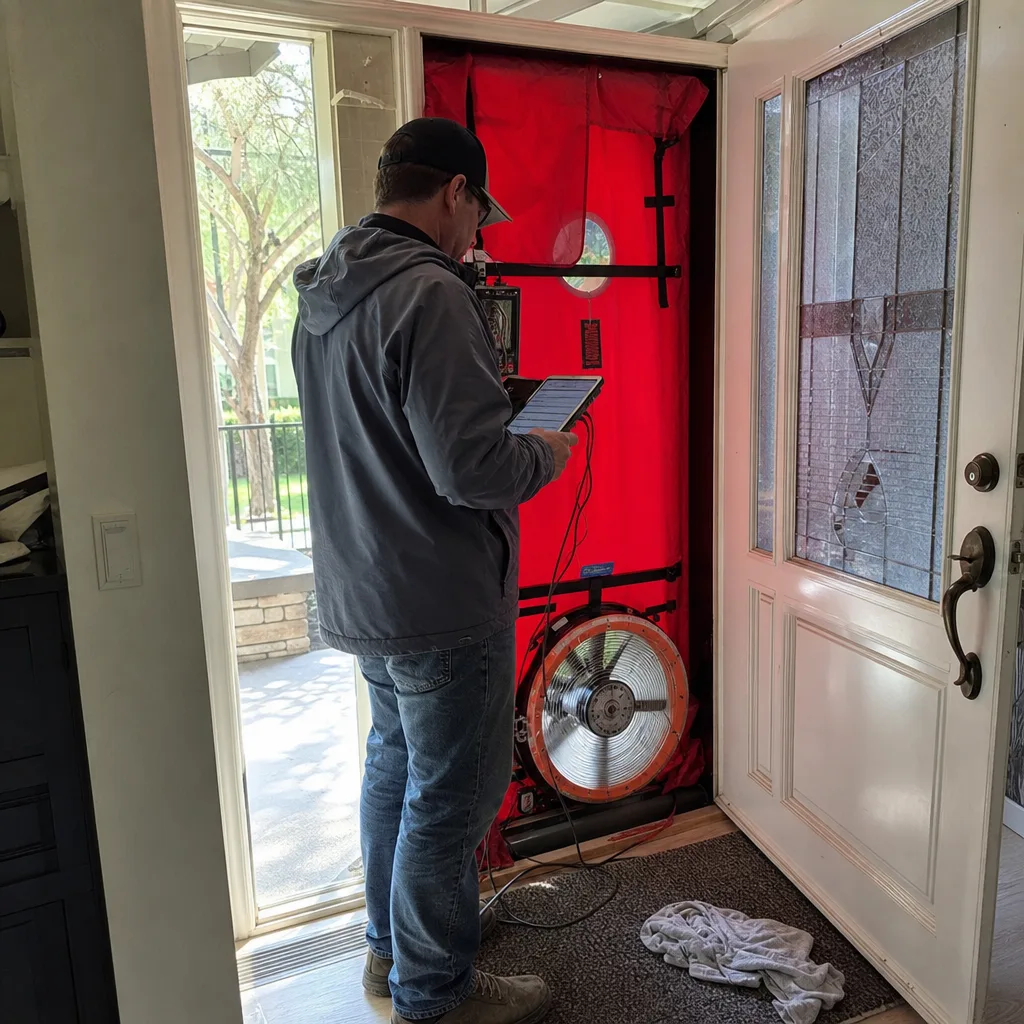
A blower door is a calibrated fan that mounts in an exterior door frame and depressurizes the house to 50 Pascals below outdoor pressure. The resulting airflow, measured in cubic feet per minute (CFM50), is converted to Air Changes per Hour at 50 Pascals (ACH50) - a standardized number that allows comparison across homes of different sizes.
For a typical Lake Forest home of 1,800-2,400 square feet built in the 1980s, here’s how to interpret the number:
- Below 3 ACH50: Tight envelope, likely built with attention to air sealing or recently upgraded. Mechanical ventilation may be required.
- 3-5 ACH50: Reasonable performance for the era. Some improvement possible, but not urgent.
- 5-7 ACH50: Leaky envelope. Conditioned air is being lost at rates that measurably increase energy costs and comfort complaints.
- Above 7 ACH50: Severe leakage. In a 2,000 square foot home with 8-foot ceilings, 7 ACH50 means roughly 40% of your conditioned air is exchanging with outside air every hour. Your HVAC is conditioning air that immediately leaves the building.
We’ve tested Lake Forest homes across the full range. A 1987 Foothill Ranch tract home recently measured 9.2 ACH50 - the equivalent of leaving a 2×2 foot window open year-round. After air sealing and insulation upgrade, it tested at 4.1 ACH50. The homeowner’s summer cooling costs dropped 34%.
The value of a blower-door test is that it gives you one number to track. Before-and-after readings are how we document that our work performed as promised. Under the Haven Standard, we publish these numbers on every applicable job. You receive the documentation; you verify the result.
Reading HVAC Runtime Patterns Before the Thermostat Complaint
Most homeowners notice an insulation problem when they’re uncomfortable. But the HVAC system tells the story earlier, if you know how to listen.
Modern thermostats - even basic programmable models - log runtime data. Access yours and look for these patterns:
- Extended afternoon runtime in summer. If your system runs continuously from 2 PM to 6 PM in August, it’s not “working hard” - it’s losing ground to heat gain faster than it can remove it. In Lake Forest, where design temperatures hit 92°F, a properly sized and sealed system should cycle, not marathon. Continuous runtime indicates envelope failure, not equipment undersizing.
- Short-cycling in mild weather. Rapid on-off cycles when outdoor temperatures are in the 70s mean the system is satisfying the thermostat quickly because the actual load is low, but it’s doing so inefficiently. This pattern often correlates with thermal bridging: the system responds to localized heat gain at top plates or duct chases, not to whole-house demand.
- Differential runtime between floors. If your upstairs zone (or upstairs unit, in a dual system) runs 40% longer than downstairs, the cause is almost always attic duct leakage or insufficient insulation over the upper floor. In Lake Forest’s two-story homes, this pattern is so reliable we use it as a pre-diagnostic before we even enter the attic.
Your HVAC contractor can pull detailed runtime logs if your thermostat doesn’t display them. Bring a month of data to a Home Energy Audit in Lake Forest and we’ll correlate it with blower-door and infrared findings.
Thermal Bridging at Top Plates: The Hidden Baseload Killer
Thermal bridging is the heat highway that bypasses your insulation entirely. In Lake Forest’s predominantly wood-framed construction, the most significant bridge is the top plate - the horizontal 2×4 or 2×6 that caps every wall and sits directly in contact with attic air.
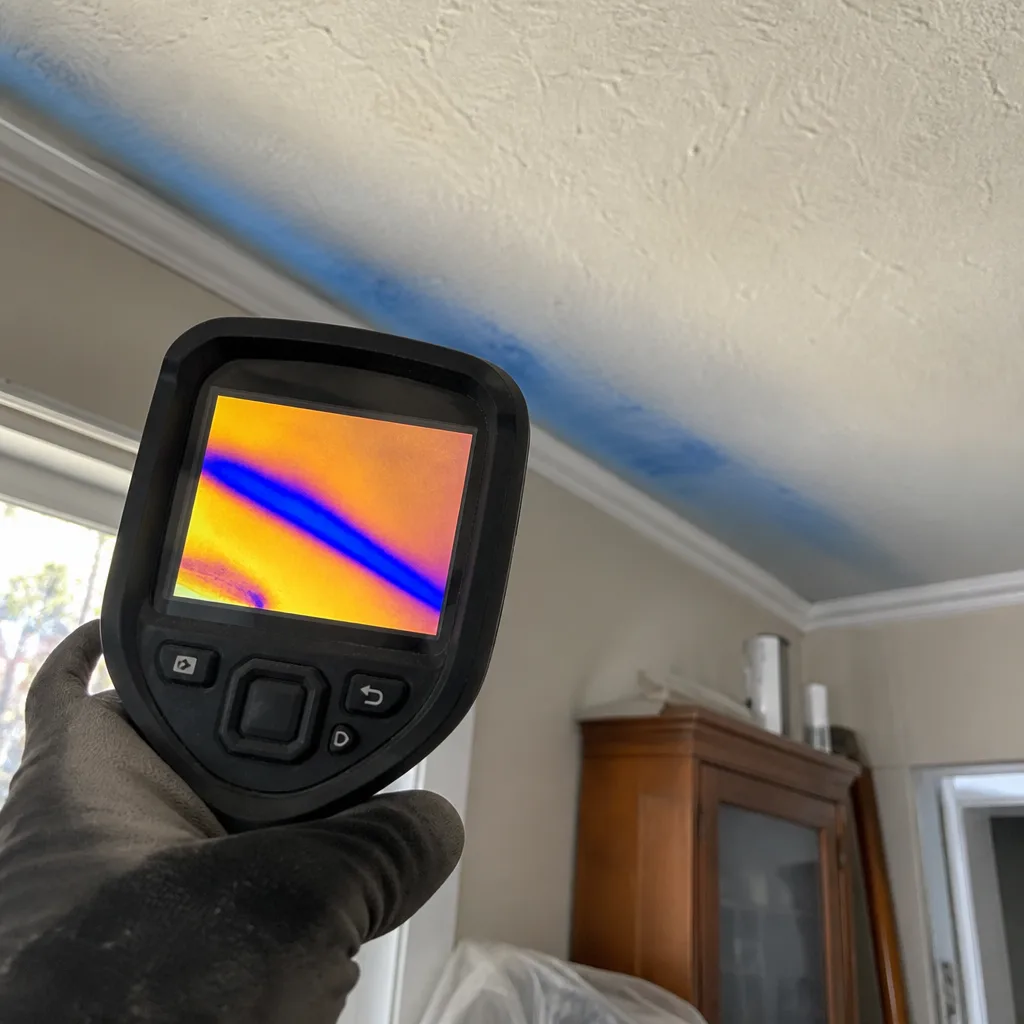
A typical 2,000 square foot home has 300-400 linear feet of top plate. At R-1 per inch, a 2×4 top plate is R-3.5 where it crosses the insulated attic floor. The surrounding insulation might be R-30 or R-38, but the heat flows through the path of least resistance. In infrared imagery, top plates show as bright stripes - thermal freeways carrying heat out in winter and in in summer.
The effect on your bill is insidious. Because it doesn’t produce dramatic temperature swings, thermal bridging doesn’t generate comfort complaints. It simply elevates your baseload - the energy you consume when you think nothing is running. We’ve measured baseload reductions of 18-25% in Lake Forest homes after comprehensive top plate sealing with rigid foam and spray foam, with no change to wall or attic insulation.
Detection requires either infrared imaging or a careful visual inspection. Look for gaps between the top plate and drywall ceiling, especially at wall intersections and partition walls. These gaps are often covered by insulation but remain unsealed air paths. A proper air seal addresses the gap, not just the visible surface.
For homes with significant thermal bridging, we sometimes recommend Crawl Space Encapsulation & Vapor Barrier in Lake Forest as part of a whole-envelope approach, particularly where rim joists create similar bridge conditions at the foundation level.
Common Mistakes to Avoid
- Calling the HVAC contractor first for a comfort complaint. In Lake Forest, 60% of “HVAC problems” we investigate trace to envelope failure, not equipment failure. A $15,000 system replacement won’t fix attic air leakage.
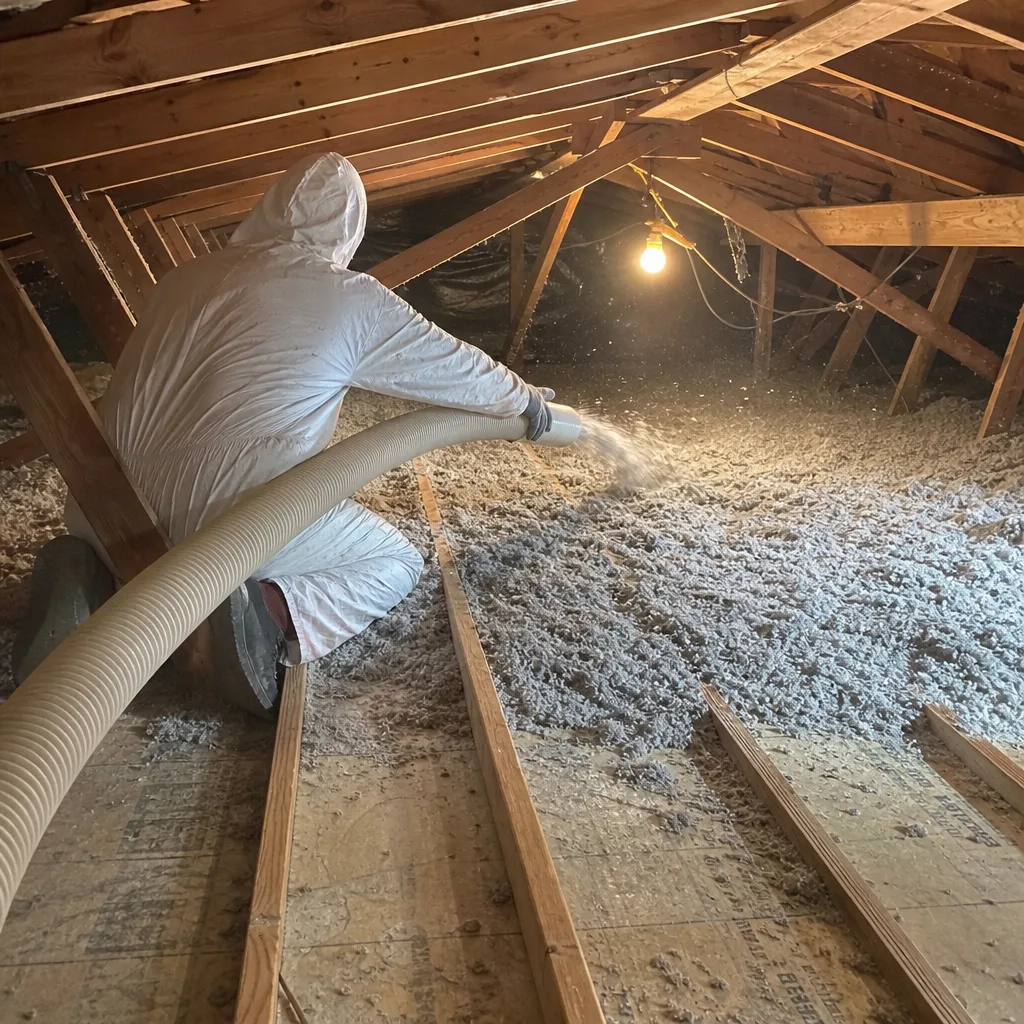
- Adding insulation without air sealing. Blowing fiberglass or cellulose over an unsealed attic floor buries the problem, makes future sealing more expensive, and can trap moisture against the drywall. We see this mistake weekly in homes where homeowners accepted a low bid that skipped the prep work.
- Ignoring mild-weather energy increases. A bill that creeps up in April and October, when HVAC use is minimal, indicates baseload problems - thermal bridging, duct leakage, or continuous fan operation. These are envelope issues, not equipment issues.
- Storing items directly on attic insulation. Every storage platform compresses insulation beneath it and creates a thermal bridge. If you need attic storage, raise platforms on 2×4 sleepers to preserve full insulation depth.
- Blocking soffit vents with insulation. Proper attic ventilation requires a clear path from soffit to ridge. Insulation pushed against the eave blocks intake airflow, raises attic temperatures, and can cause moisture problems. Baffles - cardboard or foam channels - must be installed before insulation is added at the eave.
- Accepting a verbal estimate for insulation work. Under Haven Standard Clause 1, every job begins with a written price, written scope, and written warranty. Verbal estimates leave room for scope expansion, material substitution, and warranty disputes. We’ve repaired jobs where the “estimate” doubled by completion.
- Skipping pest remediation before re-insulation. Installing new material over active rodent contamination voids manufacturer warranties and guarantees repeat damage. The correct sequence is: proof, remove, treat, seal, insulate.
When to Call a Professional
Call for a professional assessment when you’ve documented any of the following: a 15% or greater year-over-year increase in cooling costs, room-to-room temperature differences exceeding 4°F, visible attic floor decking during your inspection, moisture on the roof deck in February, or pest activity indicators in the insulation. These conditions rarely resolve themselves and typically worsen with seasonal temperature extremes.
Topside Attic Insulation Lake Forest offers free estimates in Lake Forest - call (657) 279-1249. Every estimate includes a written scope and written price before any work is discussed. We also provide free second opinions on any written estimate you’ve received from another contractor; bring us their scope and we’ll review it with you, line by line.
Frequently Asked Questions
Most comprehensive attic air sealing and insulation upgrades in Lake Forest homes of 1,500-2,500 square feet run between $3,800 and $7,200, depending on existing conditions, accessibility, and whether pest remediation or insulation removal is required. We provide a written price before any work starts - no exceptions. Call (657) 279-1249 for a free estimate with exact numbers for your home.
You can, but you shouldn’t - not without air sealing first. Adding insulation over an unsealed attic floor buries air leaks, makes future access difficult, and can trap moisture. In Lake Forest’s climate, we’ve seen this approach produce mold conditions within 18 months. The correct sequence is seal, then insulate. We won’t do it any other way.
Plot 24 months of usage data month by month. A step-change increase that aligns with summer cooling, with no rate change or occupancy change, strongly indicates attic air seal failure. A gradual year-round increase suggests baseload problems like thermal bridging or duct leakage. Bring your data to a home energy audit and we’ll correlate it with blower-door testing.
Repair is rarely cost-effective for fiberglass batts older than 15 years. Settling, compression, and air infiltration have degraded performance beyond what spot repair can restore. Blown-in replacement over a properly sealed floor typically delivers better ROI than partial remediation. We evaluate this case by case and give you both options in writing.
A blower-door test is a pressurization measurement that shows, in one number, how much air your building envelope is losing. For Lake Forest homes built 1980-1995, we recommend it before any insulation work. The test takes 45 minutes, produces actionable data, and gives you a baseline to verify improvement. We publish before-and-after numbers on every applicable job.
Blown fiberglass and cellulose maintain effective performance for 20-30 years if undisturbed and uncontaminated. But in Lake Forest’s attics, disturbance from pests, tradespeople, and homeowners is common, and air infiltration degrades performance much faster than age alone. We’ve found 12-year-old insulation performing at 40% of rated R-value due to air washing - dirt carried by moving air that progressively fills voids and reduces loft.
The Bottom Line
Insulation failure in Lake Forest homes announces itself through data, not drama. Learn to read your utility bills for step-changes and baseload anomalies. Spend ten minutes in your attic with a flashlight and tape measure. Note condensation patterns in February, not just July comfort complaints. And understand that the fix is always seal first, then insulate - in that order. Documentation beats promises every time: written price, written scope, written warranty, and blower-door numbers that prove the work performed. For more guides & resources, visit our blog.
Written by Wes Okafor, Owner at Topside Attic Insulation Lake Forest, serving Lake Forest since 2016.